Quality Is Not Always GMP: When ISO 9001 Is Sufficient—and When It Is Not
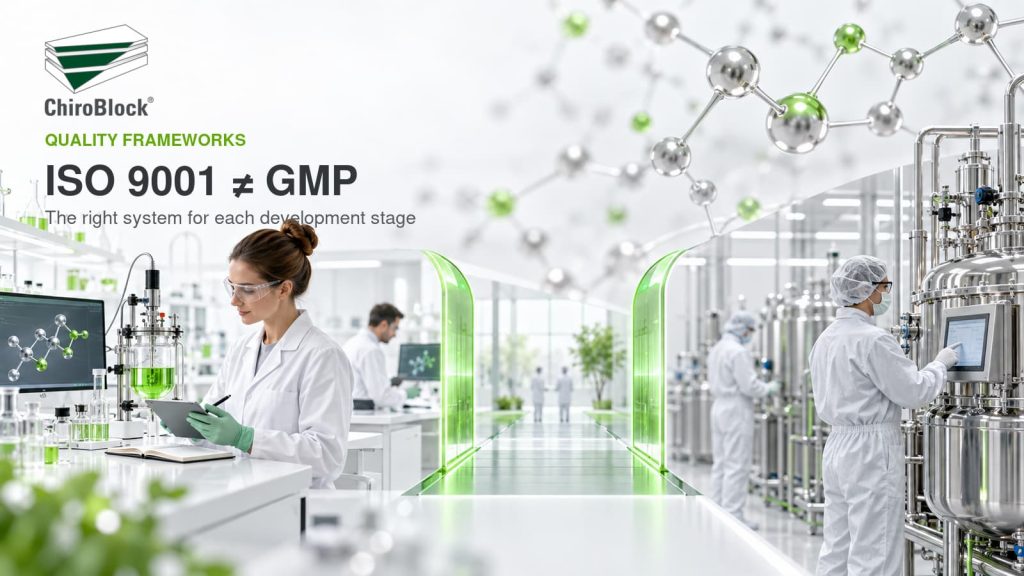
One Goal, Two Systems: Why “Quality Management” and “Good Manufacturing Practice” Must Not Be Confused
By Dr Oliver Seidelmann | ChiroBlock GmbH
At a glance
Short answer: ISO 9001 and GMP are not interchangeable. ISO 9001 is a general quality-management standard and can support disciplined route scouting, synthesis development and other non-GMP project work. GMP is the regulatory quality framework that applies when the product, process stage and intended use fall within the relevant medicinal-product or API requirements. For a new API, a staged model can combine flexible chemical R&D with early alignment to the future GMP manufacturer, followed by a controlled transfer. The exact boundary must be defined for the project, jurisdiction and intended use.
Regulatory orientation only: the applicable quality framework must be assessed for the specific project.
Key takeaways
- ISO 9001 certification does not confer GMP status and cannot substitute for applicable GMP requirements.
- Early route scouting and synthesis optimization may benefit from a flexible, quality-managed chemical R&D environment when non-GMP work is permitted.
- The intended use of the material, development stage, jurisdiction, specification and documentation needs determine the appropriate framework.
- The future GMP manufacturer should be involved early enough to align process, analytics, impurity control, scale-up and transfer expectations.
- Responsibilities at the interface between the chemical CRO and GMP manufacturer should be defined before work begins.
Questions this article answers
- How do ISO 9001 and GMP differ in purpose, scope and regulatory basis?
- When can a quality-managed chemical CRO support API route development outside GMP?
- Why can selecting a GMP manufacturer too early limit route-development flexibility?
- Why can a non-GMP manufacturer without strong chemical R&D and transfer awareness create later risks?
- How should a chemical CRO and GMP manufacturer divide work and manage the transfer?
Current standards status
Editorial status check, 9 September 2026: ISO lists ISO 9001:2015, including Amendment 1:2024, as the current edition and expects ISO 9001:2026 to replace it in September 2026. EU GMP guidance remains organised in EudraLex Volume 4. ICH Q7 covers GMP for APIs and describes increasing GMP stringency from the documented introduction of the API starting material toward final processing. Check the current edition and applicable regional rules again immediately before publication or later revision.
If you have been working in a GMP compliant company for a long time – please stop reading, you will not learn anything new.
Naturally, everyone, grown up in a clearly defined environment gets to know everything of this very environment over time. However, if they talk to outsiders, they realise – there are other worlds out there and both parties encounter issues of understanding each other.
If you have nothing to do with chemical manufacturing or with developing new active pharmaceutical ingredients (APIs), you also may stop reading.
The topic doesn’t belong to the most exciting ones. If you continue reading though – you add some very special pieces of knowledge to your memory that might cause admiration when dosed carefully in dedicated sophisticated small talk rounds.
For all who just enter the long road from a newly developed API candidate compound to the manufacturing of a drug, this short summary might be a good starting point of getting a first and rough overview.
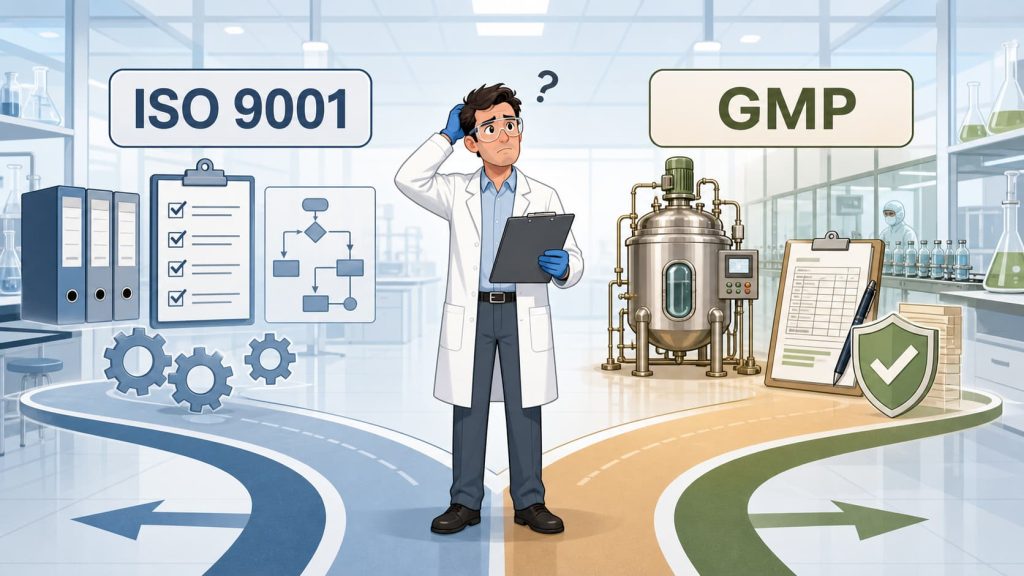
ISO 9001 and GMP in practice
So, where to start with the tour?
Let’s begin with a short investigation of the background of both terms and systems:
What is “ISO 9001” all about[1]?
- It is a quality management system (one of many possible).
- It is focused on improving the customer satisfaction in general.
- Hence, it comprises the entire company with all its processes, departments, staff, infrastructure.
- The regulations were set up by an independent organisation that sought to find a quality management frame for every type of business, for every industry, for all kinds of products and services.
- The regulations defined are not based on laws but on practical experiences.
- The implementation of a very QM system is always voluntarily.
- The ISO 9001 system starts with a risk based approach, followed by a continuous cycle of improvement.
- ISO 9001 helps to convince potential customers that the products / services are of good quality.
- The system gets audited by independent external auditors (and customers).
What, on the other hand, does “GMP” mean in practice[2][3]?
- It is focused on the product quality.
- The regulations are based on clearly defined laws.
- These laws differ from country to country (or economic area to economic area).
- If a manufacturer intends to manufacture a GMP regulated product, they do have no choice – they must adhere to the GMP rules.
- GMP is definitely required for APIs, for drugs, for many other products that have to be of very high and constant quality because – otherwise – they would cause damage to human beings.
- GMP gets audited by the local authorities (and customers).
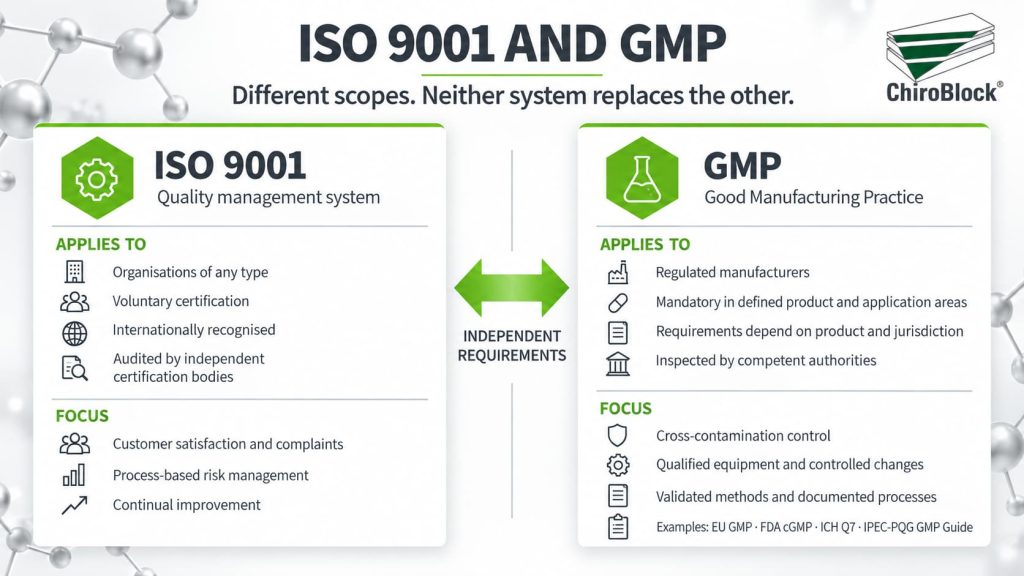
I think the main differences have already been described above.
What are common features and consequences?
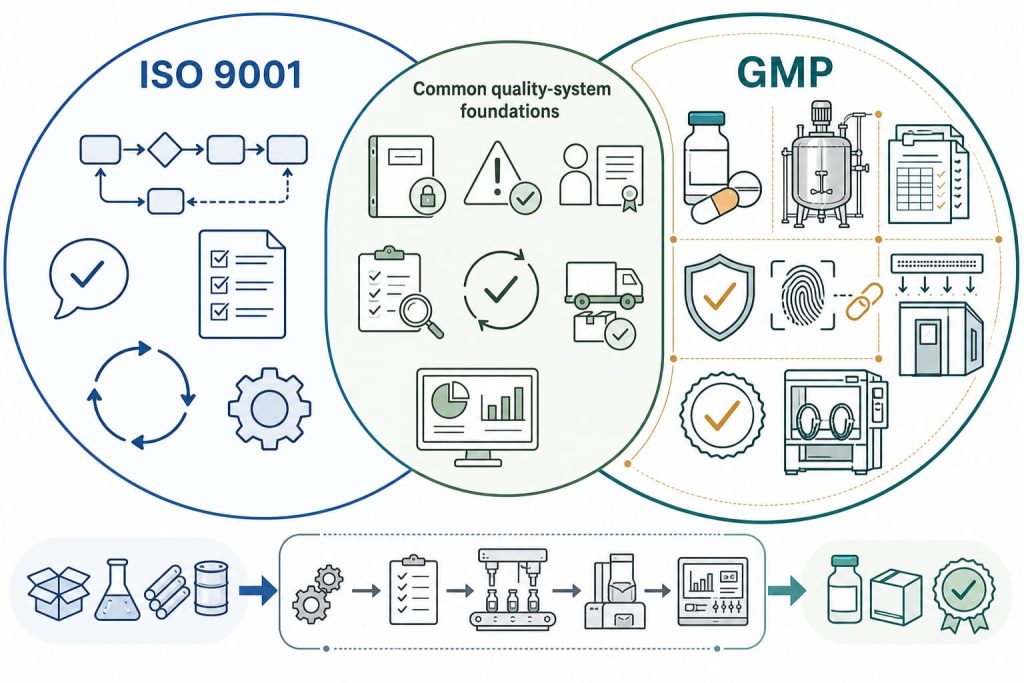
As you can imagine, quite a lot of common features do exist[4]:
- Description of clear internal processes for providing services / for manufacturing products
- Calibration of analytical instruments
- Education / qualification of the staff involved
- Change management
- Traceability of the material flow
- Measures regarding hygiene, maintenance and quality control
- Audit procedures
- Clearly defined processes for customer complaints and out-of-specification products
Sounds irritating?
Please, do not give up here after all the enumerations of partial common and (partial) different features!
I will try to shed more light on the really important facts:
- First: Both systems are generally different because their roots and their basis are different.
- Second: As these systems are different, they can not substitute each other.
- Third: As the GMP requirements result from laws addressing special products, there are less GMP-compliant companies out there than ISO 9001 organised ones.
- Fourth: One can run a company with just one of these systems – however, if GMP is required, it makes sense to also have an ISO 9001 QM system in place.
- Fifth: While both systems finally improve the competitiveness of a company, they cost money – both in setting them up and in maintaining them.
- And – last but not least: Working under GMP necessarily reduces the flexibility of a company.
To be more specific:
What does that mean for someone looking for (chemical) companies that develop a synthesis of a new API candidate, that prepare sample amounts for the different clinical test phases, that finally manufacture this API in the best case?
According to my experiences, many academic groups and start-up companies do not know the answer to this essential question.
They often are aware of the approaches of medicinal chemistry, of finding potential API candidates, of optimising their properties. However, having identified the best molecule, they sometimes are overwhelmed to carefully select the next step, to identify the best partner for the starting industrialisation and commercialisation of their invention.
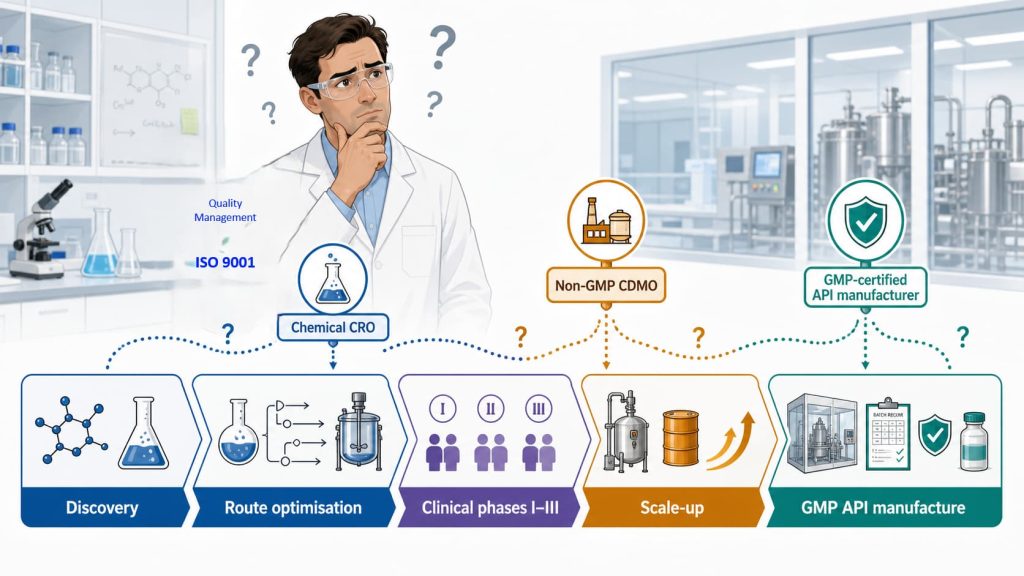
While – depending on the very situation – some different approaches are possible, there are two options that definitively are not optimal:
- Selecting a GMP-manufacturer right from the beginning
- Selecting a chemical (non-GMP) manufacturing partner
The problems with option 1. are:
- These companies normally do neither have the resources nor the flexibility to really thoroughly develop and optimise the synthesis route to the API compound consequences:
- The GMP – manufacturing process is based on a sub-optimal chemical route
- Resulting in too high “locked-in” costs during the entire manufacturing period
- The chemistry related developmental work (if offered at all) is expensive and will miss many options due to the lacking flexibility
The advantages are:
- The partner is aware of all issues of a GMP compliant production right from the beginning.
- One avoids too many partners and intersections and transfer problems.
The problems with option 2. are:
- These companies are not working according to GMP and – hence, might miss / neglect many important steps and activities required for a later GMP compliant production. This will result in tremendous delays and unnecessary costs later on.
- A chemical (non-GMP) manufacturer – while being more flexible in principle – mostly lacks the capabilities for real chemical r&d work. So, comparable to option 1. – one may end up with a suboptimal route.
- More partners are required with all the problems of process transfers and respective intersections.
The advantages are:
- The prices are lower, the flexibility higher.
- It is possible to get larger amounts of the product based on industrial (scalable) operations and available starting materials.
What would be a better approach?
If one looks at all the above listed pros and cons, the conclusion is quite clear:
- The thorough development / optimisation of the synthesis process is mandatory for a later cost efficient production of the API.
- This work should be devoted to a partner who is focussed on chemical optimisation and process design and who is not working under GMP guidelines (but a QM system like that of ISO 9001 would be recommended). These companies belong to the industry of “chemical contract research organisations” – short “chemical CROs”.
- The later GMP manufacturer should also be selected as soon as possible – preferably together with the chemistry CRO.
The additional intersection between the chemical CRO and the GMP-manufacturer is no problem if the following aspects are considered:
- The chemical CRO is aware of all later GMP requirements
- Both companies trust each other or even have been working together for a longer period of time.
- Both companies are working closely together from the start of the mere chemical optimisation to the final process transfer.
- The tasks of both partners have to be clearly defined at the beginning as to avoid double work and unnecessary costs.
If these hints are considered, the originator of a new API molecule benefits from the best of both worlds (the GMP and the non-GMP but ISO 9001 sphere):
- Excellent, robust, high yielding, cost efficient chemical process
- Early availability of all necessary GMP data, samples, methods, documentations
- Seamless transfer to a suitable manufacturer
- Reliable availability of the API in the required quantity and quality at all stages
ChiroBlock, as a typical CRO having a proved and certified ISO 9001 quality management system, regularly accompanies such processes to an API production at a GMP partner.
This encompasses not only the chemical and analytical work but also the recommendation and selection of a GMP manufacturer as well as all consulting work required for “newcomer” in this demanding field.
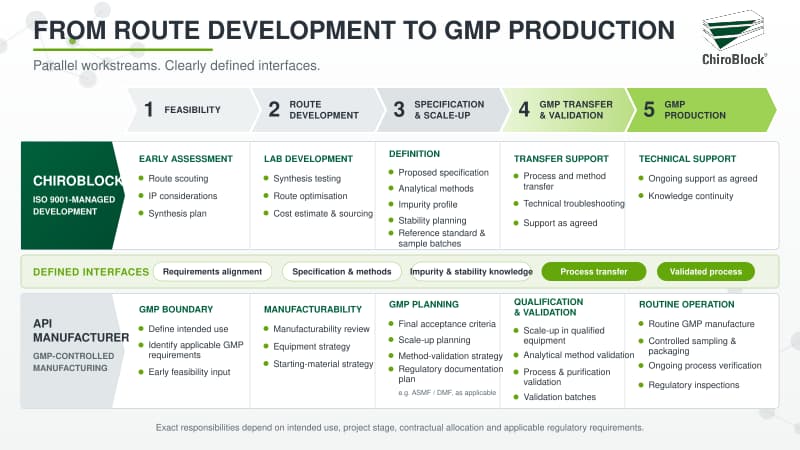
The following slide shows a possible (and proved) division of tasks between ChiroBlock and the GMP partner as well as the potentially overlapping field of work the assignment of which needs to be negotiated and contractually fixed:
Conclusion
So, do not get worried or distracted by terms like “ISO 9001” or “GMP” when trying to bring a new compound (API) to market.
If selecting the right partners and advisors, this always challenging route doesn’t have to get lost in foreseeable dead ends.
Regardless of whether you provide services along this path or you were looking for such services – I am eager to hear about your experiences and opinions!
#ChiroBlock, #CRO, #API, #chemicalCRO, QualityManagement, #ISO9001, #GMP
Frequently asked questions
What is the main difference between ISO 9001 and GMP?
ISO 9001 is a general standard for an organization’s quality-management system. GMP is a product- and process-specific regulatory framework for manufacturing medicinal products and active substances where the applicable rules require it.
Can ISO 9001 certification replace GMP?
No. ISO 9001 certification can demonstrate a structured quality-management system, but it does not confer GMP status and cannot replace the GMP requirements that apply to a regulated product, process stage or intended use.
When can an ISO 9001-certified chemical CRO support API development outside GMP?
An ISO 9001-certified chemical CRO can support route scouting, feasibility work, synthesis development, optimization and other non-GMP activities when the material’s intended use and the applicable requirements permit it. Specifications, documentation and later transfer requirements should be defined from the outset.
When must GMP be applied to API manufacture?
Applicable GMP must be followed when the material is manufactured for a use and at a process stage covered by medicinal-product or API requirements. ICH Q7 describes the documented introduction of the API starting material as a key boundary and states that GMP stringency should increase toward final API processing.
Why should the future GMP manufacturer be involved early?
Early involvement helps align the synthesis route, impurity strategy, analytical methods, documentation and scale-up package with the receiving manufacturer’s requirements before the process becomes difficult or expensive to change.
What should be defined between the chemical CRO and the GMP manufacturer?
The parties should define the intended use, GMP starting point, target specification, analytical and process-transfer package, responsibilities, change control, acceptance criteria, timelines and ownership of data and intellectual property.
Related ChiroBlock resources
- DIN EN ISO 9001 Certificate — current ChiroBlock certification information
- Chemical Custom Synthesis & Contract Research — first-time synthesis and development of complex, commercially unavailable molecules
- Process Development & Synthesis Route Scouting — route scouting, redesign and synthesis optimization
- A Custom Synthesis Project at ChiroBlock — example workflow from request and feasibility assessment to delivery and scale-up
About the author
Article author: Dr Oliver Seidelmann, chemist, Managing Director and Co-Founder of ChiroBlock GmbH
Relevant expertise: synthetic chemistry, chemical custom synthesis, synthesis-route development, commercialization and industrial transfer
Scientific profile: Oliver Seidelmann on ResearchGate
Professional profile: Oliver Seidelmann on LinkedIn
Planning an API route and transfer strategy?
Discuss route scouting, process development, documentation and transfer requirements with ChiroBlock before the project becomes locked into a manufacturing setup. Contact ChiroBlock.
Sources and further information
- ISO 9001:2015 Guidance on Documented Information ↩
- European Commission EudraLex Volume 4 Good Manufacturing Practice Guidelines ↩
- European Medicines Agency Guidance on GMP and GDP Questions and Answers ↩
- GMP Publishing GMP Is Not ISO 9001 Where Are the Similarities and Differences ↩
- ISO 9001:2015 Quality management systems Requirements — official ISO edition and revision status
- ICH Q7 Good Manufacturing Practice Guide for Active Pharmaceutical Ingredients — official ICH guidance on API GMP scope and the API starting-material boundary
- ChiroBlock DIN EN ISO 9001 Certificate — current company certification page