
Securing the supply chain in API production – an (un)usual task for chemical CROs?
Nominal purity alone may not ensure reliable performance. Identifying critical quality and process parameters can enable consistent supply from qualified sources.
Case study summary: A pharmaceutical company repeatedly experienced variable performance from commercially sourced (E)-4-phenylbut-3-enoic acid despite a nominal purity of 99% and an apparently suitable specification. ChiroBlock investigated the quality gap, identified critical solid-state, solvent, process and starting-material parameters, developed a robust synthesis and recrystallisation procedure, supplied several kilograms before existing stocks were depleted and transferred the process to another CMO to support continuous supply.
- Material: (E)-4-phenylbut-3-enoic acid
- Application: Auxiliary agent used in an API synthesis
- Initial problem: Nominally compliant batches did not perform consistently
- Project scope: Root-cause investigation, analytical-method development, synthesis, purification and process definition
- Project result: Kilogram-scale material, a robust process and two independent supply sources
Scope note: This case concerns an auxiliary chemical used during an API synthesis. It does not state that ChiroBlock manufactured the API or performed cGMP API production. ChiroBlock operates an ISO 9001-certified quality management system; regulatory and documentation requirements must be defined separately for each project. See ISO 9001 vs. GMP in API development.
Article author: Dr Oliver Seidelmann, Chemist, Managing Director and Co-Founder of ChiroBlock GmbH
Relevant expertise: Synthetic chemistry, chemical process development, scale-up and customer-specific chemical supply
Editorial review: ChiroBlock GmbH
Published: 23 September 2026
Why did a commercially available chemical become a supply risk?
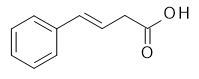
The compound “(E)-4-phenylbut-3-enoic acid” has got every feature a supply chain manager in the industry is dreaming of:
- It has been known for many decades (remember: due to the exponential dependence of new discoveries on time, the majority of all compounds always is younger than five to ten years)
- It has already been assigned a CAS# (this is no matter of course!)
- It is commercially available! (remember: most chemical substances are not)
- It was already registered at the ECHA (below REACH level)
- There are more than two dozens suppliers
- It can be sourced from several areas in the world
- Also multi kilogram amounts are available
- The price is acceptable
- One can choose from a variety of different grades – up to 99%
- The synthesis is straightforward and scalable
So, everything seems to be fine from a supply chain point of view.
However – taking a closer look, this conclusion does not really hold true.
Why did the existing specification not predict application performance?
A pharmaceutical company needing this substance as auxiliary agent for an API synthesis, regularly were facing problems when using it.
They had already purchased the material of a very high purity with a specification that seemed to meet all requirements:
- 99% purity
- cis isomer < 0.1%
- residual solvents <0.1%
- all solvents meeting the ICH guidelines
- inorganic impurities: <0.05%
BUT:
Sometimes, this material worked, sometimes not –
The nightmare of the product management in an API production.
They did not know the reason(s). The only observation from QC was a slightly yellowish colour and a slightly different melting point with the low performing material.
So, the trouble-shooting started under the pressure of tight timelines:
- The supplier was asked for information on changes: no changes were disclosed
- The supplier was audited – with no critical findings
- The supplier was asked to re-work the product despite no specification parameter being oos: – the result was even worse: apart from the material being still slightly coloured and somewhat hygroscopic, residual hexane was detected far beyond the ICH threshold…
- Time was running out..
- Stocked (good) material was about to get depleted..
- The ugly word of “production halt” started to linger about the pharmaceutical company..
Why was a chemical CRO brought into the project?
A situation to look for external support.
Who would be able to help?
An analytical lab investigating the impurity?
The internal QC searching for alternative release conditions?
Another supplier that could perform better?
A service provider blending different qualities / batches of the product as to meet spec?
An independent research institute thoroughly investigating the synthesis procedure and the by-products profile?
However, each of these options would take too much time with no guarantee of success.
So, it certainly was a good idea to look for a chemical CRO in this scenario – a CRO combining expertise, flexibility, speed, an understanding of the industry and appropriate, results based contract options.
In this very case, ChiroBlock – a German chemical CRO with more than 25 years of experiences - was asked to investigate the issue and – most importantly – to solve it within a time span of maximal eight weeks.
From our point of view, definitely a wise decision
How did ChiroBlock investigate the quality gap?
We do know that sometimes even simple and well known compounds pose substantial problems. In contrast to pure analytical labs, we could not just analyse the product but also synthesize and purify it in several parallel approaches.
The initial conclusions were obvious – but had been overlooked so far:
If the quality differs from batch to batch – the process at the supplier’s side bears a critical parameter that also varies from batch to batch.
Or – in other words (in fact - a truism):
If the result of any activity is different – there must be a deviation in the activity.
As the supplier did not disclose every detail, our task was challenging:
- To find this deviation / the critical parameter of the production (without ever having produced this compound)
- In parallel: to develop a re-working method for the poor material in case we do not manage to find the critical parameter in time
- Develop appropriate analytical methods to close “the blind gap” as to prevent QC from releasing low-performing material
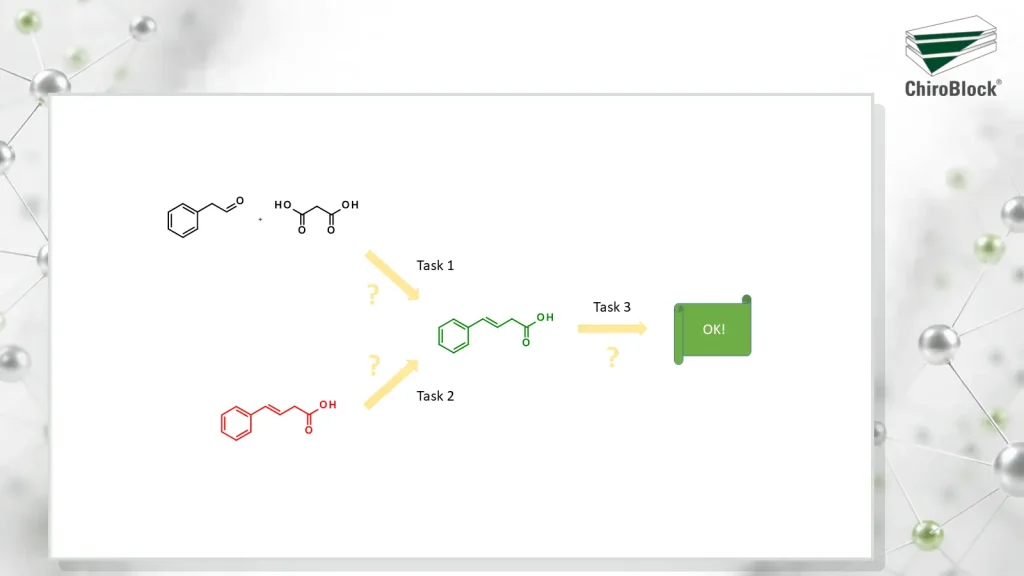
ChiroBlock pursued three tasks in parallel: identify the critical production parameter, develop a reworking method and close the analytical blind gap.
How was the synthesis and purification process investigated?
So we started work:
All we knew was that a recrystallization using hexane obviously was tried and did not improve the quality.
And we knew the published synthesis routes to make “(E)-4-phenylbut-3-enoic acid”.
The options here were limited and basically boiled down to a Knoevenagel-Doebner condensation as follows:
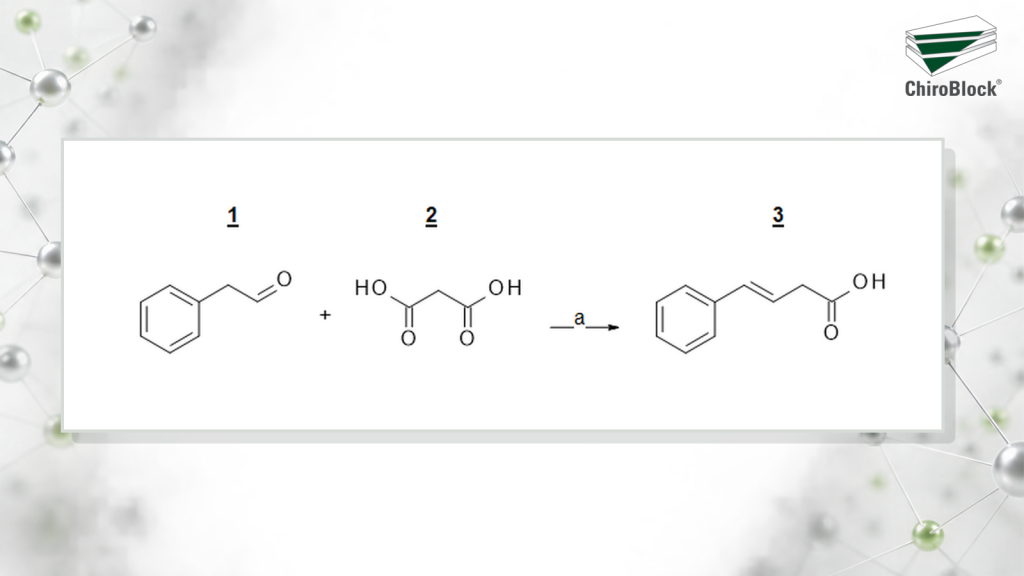
The published synthesis routes for the target compound largely converged on a Knoevenagel–Doebner condensation.
So, just the phenyl acetaldehyde has to be condensed with malonic acid.
While this is undergraduate organic chemistry level – it obviously looks more simply than it actually is.
Remember: The product of this reaction substantially varied in quality!
Chemical CROs like ChiroBlock are well prepared for tasks that appear deceptively simple yet being complex:
- They have gained experiences with nearly every type of chemistry
- They approach such problems via an unbiased way
- They do have both the scientists – being the experts of chemical sciences - and the technical engineers who contribute the technological process know-how
- They are used to work under strict timelines
- They do have the flexibility and speed to quickly and appropriately adapt to the very problem
- They are open to different contract models that correspond to the project
- They work exclusively for customers under strict confidentiality
- They do not have the need to fill manufacturing vessels with new products – so there normally is no conflict of interests
- They normally always can initiate new projects within 1-2 weeks
To make it short: ChiroBlock finally succeeded in solving the problem (as you may guess – otherwise we would not talk about it here…).
What did the investigation reveal?
Here – the time-lapse of our journey towards the solution:
- First, we noticed that there exist two crystal modifications. They were detected both in our purification experiments as well as in our synthesis trials. Their formation strongly depends on the solvents used and on the time related T-c profile.
- Second, we found that especially critical solvents like dmf, hexane, cyclohexane and acetonitrile (ICH class 2 solvents) give rise to the favourable (colourless) modification but resulting in too high residual solvent figures.
- Third, we saw that also the specifications of the two main starting materials were critical with regard to two parameters.
- After five weeks of intense work, we came up with a solution that not just allows to purify the product but we also were able to fix the synthesis process details in a way that makes it robust enough for a validated manufacturing protocol.
Without publishing every detail here – I just would like to mention one specific detail regarding the recrystallization solvents:
It proved to be impossible to find one specific solvent that both yields the right crystal type and that did not give too high residual content numbers. So we switched to a solvent mixture consisting largely of one benign and only to a small extent of one critical liquid. In addition, the still wet precipitate after the filtration step was washed with water to minimise the observed tendency to enclose (critical) solvent molecules into the product crystals during the drying process.
How was the API production supply chain secured?
With this new toolbox in hand – the defined synthesis process and the developed re-crystallisation procedure – we were able to avoid a halt of the API production:
We quickly could synthesise some kilograms of pure material before the stocked amount became depleted.
In parallel, we transferred the new validated process to another CMO as to pave the way for a continuous supply.
In the end, the pharma customer has established a really secure supply chain now – with two independent suppliers, with a robust, validated and known process and with the awareness of all critical parameters that really matter.
I am sure that the solution would not have been found without the support of a chemical CRO.
Who else should have tackled the problem – tha pharma customer? The original supplier? Anyone else?
Have you experienced similar situations or found other approaches for a solution?
Any other (positive or negative) experiences with chemical CROs?
#ChiroBlock, #CRO, #API, #chemicalCRO, #process-development, #product-specification
What does this case demonstrate?
This project demonstrates why nominal purity, a CAS number and an apparently complete certificate of analysis may still be insufficient for an application-sensitive chemical. Solid-state form, solvent history, thermal profile, starting-material quality and process conditions can influence performance even when the conventional release parameters remain within specification.
The project also shows why analysis, synthesis, purification, specification development and supply-chain planning should not be treated as separate tasks. The relevant quality attributes must be identified, converted into measurable acceptance criteria and controlled through a reproducible process.
Further guidance is available on the following ChiroBlock pages:
- Custom synthesis of established compounds to specification and reliable supply
- Developing a chemical specification from application requirements
- Recurring supply to a custom specification and qualified second source
- Chemical process development and synthesis-route optimization
- Quality-managed manufacture of customer-specific fine and specialty chemicals
- Costs and contract models for custom synthesis projects
Frequently asked questions
Why could material with 99% purity still fail in the application?
The nominal assay did not describe all properties relevant to the application. The investigation identified two crystal modifications, solvent-dependent solid-state behavior, residual-solvent challenges and critical starting-material parameters.
Which observations indicated that an unidentified quality attribute was involved?
The low-performing material had a slightly yellowish colour and a slightly different melting point. Performance also varied between batches even though the stated specification parameters were within their limits.
What did ChiroBlock investigate?
ChiroBlock combined analytical-method development with parallel synthesis and purification experiments. The work examined the synthesis route, starting-material specifications, solvents, recrystallisation conditions and the time-related temperature profile.
How long did it take to identify a workable solution?
ChiroBlock was asked to solve the problem within a maximum of eight weeks. After five weeks of intensive work, a purification solution and robust synthesis-process details had been established.
How was the immediate supply risk addressed?
ChiroBlock synthesised several kilograms of the required material before the customer’s existing stock was depleted.
How was continuous supply established?
The newly defined process was transferred to another CMO. This enabled the customer to establish two independent sources supported by a known process and awareness of the parameters that were critical to performance.
Did ChiroBlock manufacture the API under cGMP?
No such claim is made. The compound described here was an auxiliary agent used in an API synthesis. The case study concerns chemical investigation, process development, supply of the auxiliary material and process transfer. Regulatory scope must be assessed separately for each project.
Can ChiroBlock investigate a similar specification or batch-performance problem?
ChiroBlock can assess whether analytical comparison, synthesis, purification development, specification work or test-batch manufacture offers a technically meaningful route. Feasibility depends on the compound, available samples and data, target quantity, required timeline and the customer’s application test.
Discuss Your Specification and Supply Challenge