
Recurring Supply to a Custom Specification and Qualified Second Source
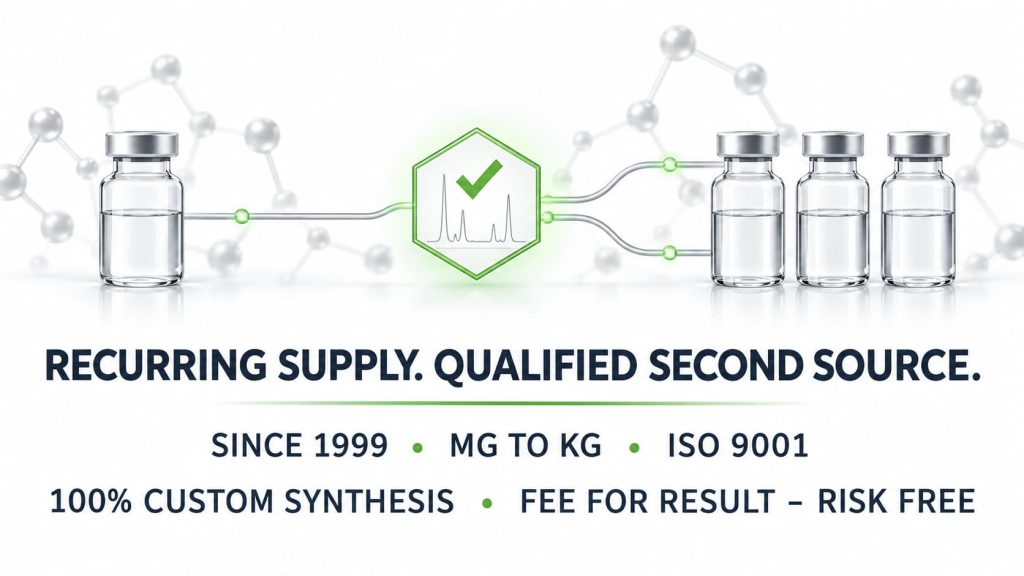
A qualified second source combines an agreed specification, controlled manufacture, release testing and documented repeat supply.
DIRECT ANSWER: Recurring custom chemical supply means manufacturing an established compound repeatedly against an agreed product specification, using controlled starting materials, documented procedures, suitable release testing, traceability and defined rules for relevant changes. A qualified second source must demonstrate technical suitability against these requirements; it is not simply another company offering the same compound name or CAS number.
ChiroBlock supports customer-specific compounds from qualification-batch manufacture through documented repeat supply from gram to kilogram scale. Where an independent supply route is required, ChiroBlock can assess the compound, target specification, existing data and approval pathway needed to establish a technically qualified second source.
This service forms part of ChiroBlock’s broader pathway for custom synthesis of established compounds to specification and reliable supply.
What Is Recurring Custom Chemical Supply?
Recurring custom chemical supply is the repeated manufacture of a customer-specific compound according to agreed chemical, material, analytical and documentation requirements. Unlike catalog purchasing, the compound is manufactured for a defined customer project rather than for sale to an open market.
Definition: Recurring supply to a custom specification is the repeated manufacture and release of a customer-specific compound using an agreed process and control framework designed to reproduce the required quality across subsequent batches.
The framework may include a product or release specification, starting-material requirements, manufacturing instructions, in-process controls, release analytics, batch documentation, traceability and project-specific handling of deviations and changes.
Recurring supply does not mean that every batch will produce numerically identical analytical results. It means that relevant variation is controlled and that each released batch meets the agreed acceptance criteria.
What Is a Qualified Chemical Second Source?
A qualified second source is an alternative supplier whose material, manufacturing route, analytical results and documentation have been assessed against defined requirements and approved through an agreed qualification process.
The presence of a second supplier name in a purchasing database does not by itself establish supply security. The alternative source must be able to provide the required chemical form, quality, quantity and documentation, and its material must pass the agreed chemical and application-specific evaluation.
| Second supplier | Qualified second source |
|---|---|
| Lists or offers the same compound name or CAS number. | Provides the required compound, form and quality against defined criteria. |
| May use an unknown or different manufacturing process. | Uses a technically assessed route and an agreed control strategy. |
| Provides a standard supplier certificate. | Provides the analytical and batch documentation agreed for the project. |
| Has not necessarily been tested in the intended application. | Has passed the agreed chemical qualification and, where required, customer-side application testing. |
| May change raw materials or processes without project-specific assessment. | Relevant changes are evaluated and communicated according to the agreed framework. |
A second source therefore provides value only when its material is demonstrably suitable for the intended use. Equivalence cannot be inferred from identity, assay or a catalog specification alone.
When Is an Independent Second Source Useful?
A second-source project may be appropriate when the continued availability of a critical compound depends on a single manufacturer, product or manufacturing route.
- A catalog product has been discontinued or is expected to be discontinued.
- The existing supplier’s quality varies between batches.
- Lead times or available quantities no longer meet project requirements.
- A supplier cannot provide the required documentation or analytical detail.
- The compound is strategically important but required only in small or medium annual quantities.
- A particular impurity profile, chemical form or material property must be reproduced.
- Purchasing or quality policy requires an independently qualified alternative source.
- A customer wants to reduce dependency on a geographically or technically concentrated supply chain.
- A formerly suitable source no longer meets revised application or quality requirements.
The appropriate response is not always a complete redevelopment project. Depending on the evidence, qualification may begin with a technical review, analytical comparison, purification study or test batch.
What Must Be Defined Before Second-Source Qualification?
The qualification basis should be agreed before an alternative batch is manufactured. Otherwise, a technically successful synthesis may still produce material that cannot be evaluated or approved.
- unambiguous compound identity and required chemical form;
- intended application and relevant process conditions;
- current product, target or release specification;
- analytical procedures and required detection limits;
- known critical impurities and other quality attributes;
- reference material or data from an accepted batch;
- required batch size and expected annual demand;
- packaging, storage and transport requirements;
- documentation and traceability requirements;
- customer-side application test and acceptance criterion;
- responsibilities for review, approval and release; and
- requirements for notification or assessment of relevant changes.
If the target specification is not yet complete, available application observations, comparison batches and analytical data can be converted into measurable acceptance criteria. The detailed process is described under From Application Requirement to Chemical Specification.
How Is a Second Source Qualified?
The exact qualification pathway depends on the compound, intended use, existing evidence and regulatory context. A typical project can be divided into six stages.
| Stage | Central question | Typical result |
|---|---|---|
| 1. Define the qualification basis | Which material, quality attributes, quantities and documentation are required? | Agreed target profile, available references and identified information gaps. |
| 2. Assess technical feasibility | Can an independent and legally appropriate synthesis and purification strategy be established? | Feasibility assessment, proposed route and project stages. |
| 3. Develop the process and control strategy | How will critical impurities and material properties be controlled? | Defined starting materials, process parameters, work-up, purification and analytical plan. |
| 4. Manufacture a qualification batch | Does the batch meet the agreed chemical and material criteria? | Characterized batch and agreed analytical documentation. |
| 5. Confirm application suitability | Does the alternative material perform as required in the intended application? | Customer or designated-laboratory evaluation and qualification decision. |
| 6. Establish recurring supply | How will future batches be manufactured, tested, documented and reviewed? | Agreed release, supply, traceability and change-management framework. |
Qualification is complete only when the agreed technical and application-specific criteria have been met and the responsible customer function has approved the source. ChiroBlock does not infer functional equivalence solely from chemical identity.
Must a Second Source Reproduce the Original Manufacturing Route?
No. A qualified second source does not necessarily need to reproduce the original supplier’s manufacturing process. In many cases, that process is unknown, proprietary or unsuitable for the required scale.
The objective is to develop an independent and legally appropriate route capable of delivering material that meets the agreed quality and application requirements. A different route can generate a different impurity profile, so route knowledge, analytical comparison and application testing are important parts of qualification.
Where an existing route must be fundamentally adapted for reproducibility, impurity control or scale, ChiroBlock can support chemical process development, route scouting and synthesis redesign. If the required compound or reference material must first be prepared as a new customer-specific target, the project may begin with chemical custom synthesis through the MoleculeFactory.
How Is Batch-to-Batch Consistency Supported?
Batch consistency begins before final release testing. It depends on controlling the materials, procedures and parameters that can influence the finished compound.
Starting materials and suppliers
- defined identity and quality requirements;
- selection and assessment of appropriate sources;
- incoming inspection or testing where agreed;
- traceability of relevant materials and batches; and
- evaluation of source changes that may affect product quality.
Manufacturing and purification
- documented synthesis, work-up, purification and isolation procedures;
- defined critical process parameters;
- appropriate equipment and line-clearance arrangements;
- in-process controls where they provide meaningful process information; and
- documented yields, observations and deviations.
Release and documentation
- agreed product or release specification;
- suitable analytical procedures and acceptance criteria;
- batch-specific analytical and manufacturing records;
- review of atypical or out-of-specification results;
- retained information or samples where agreed; and
- documented release responsibilities.
End-product analysis alone cannot correct an unsuitable or uncontrolled process. The release specification and the manufacturing control strategy therefore need to be developed together.
How Are Chemical Testing and Application Approval Separated?
ChiroBlock evaluates the chemical and material quality attributes included in the agreed project scope. Functional suitability is normally assessed by the customer or a designated testing laboratory unless a different responsibility has been expressly agreed.
| Responsible party | Typical responsibility |
|---|---|
| ChiroBlock | Synthesis, purification, agreed chemical testing, batch documentation and assessment against the defined chemical criteria. |
| Customer or designated laboratory | Biological, technical, material-science or process-specific application testing and internal source approval. |
| Joint definition | Reference material, sample coding, test sequence, data format, success criteria, responsibilities and decision pathway. |
The application test should be defined before the qualification batch is evaluated. A result cannot be interpreted reliably if the reference, conditions, acceptance criterion or decision rule are established only after testing.
How Are Changes and Deviations Handled?
Changes can affect product quality even when the compound identity remains unchanged. Relevant examples include a new starting-material source, changed raw-material quality, modified process parameters, alternative equipment, a revised analytical procedure or a different packaging material.
The project should therefore define which changes require documented assessment, notification, additional analysis or renewed application testing. The exact requirements depend on the compound, intended use and agreed quality framework.
Similarly, the response to a deviation should be determined by its potential effect on the agreed product attributes. Possible actions may include investigation, additional testing, customer consultation, rejection or documented approval under a predefined process.
ChiroBlock does not make a universal promise that every change, regardless of relevance, will trigger the same procedure. Change and deviation requirements are agreed project by project.
How Is the Recurring Supply Model Defined?
A technically qualified batch does not by itself establish a complete supply model. Manufacturing and procurement teams should also agree the expected commercial and logistical framework.
- typical batch size and acceptable quantity range;
- expected annual demand;
- indicative ordering frequency;
- agreed planning and delivery windows;
- minimum order or campaign considerations;
- packaging and labeling requirements;
- storage and transport conditions;
- analytical and documentation scope;
- handling of shortage or surplus quantities; and
- process-transfer requirements if demand later exceeds the suitable ChiroBlock scale.
Safety stock, reserved capacity, fixed delivery intervals, warehousing and guaranteed lead times are not assumed automatically. Where needed, they must be evaluated and expressly agreed for the individual supply project.
Can the Manufacturing Process Be Transferred Later?
Yes, a later process transfer can be considered if customer demand moves beyond the appropriate ChiroBlock scale or if another manufacturing arrangement becomes strategically preferable. The technical, documentation, IP and usage-right requirements must be agreed for the specific project.
ChiroBlock’s role can therefore extend from developing and qualifying a small-volume process to demonstrating its robustness through repeat manufacture and preparing an appropriate transfer package. A transfer is not automatic; its scope and deliverables must be included in the project agreement.
How Does ChiroBlock Support Recurring Supply?
ChiroBlock’s SupplyChainFactory connects synthesis development with repeat manufacture of customer-exclusive fine and specialty chemicals. It is designed for compounds that are strategically important to the customer but required below conventional large-volume manufacturing scales.
Depending on the project, ChiroBlock can combine:
- custom synthesis and route knowledge;
- development of work-up and purification procedures;
- chemical analytics and specification support;
- manufacture from gram to kilogram scale;
- controlled starting-material sourcing;
- documented batch manufacture and traceability;
- project-specific change management; and
- preparation for later process transfer where agreed.
Information about the available infrastructure is provided under ChiroBlock’s synthesis laboratories and kilo-lab facilities.
What Quality-Management Framework Applies?
ChiroBlock operates an ISO 9001-certified quality management system. The system provides an organizational framework for defined responsibilities, controlled documentation, traceability and managed processes.
ISO 9001 certification is not the same as cGMP manufacture of a pharmaceutical active ingredient. Reference to IPEC-PQG GMP guidance or other quality requirements must likewise not be interpreted as a universal cGMP certification for every project or product.
The required quality, regulatory, documentation and audit scope must be evaluated and agreed before the project begins.
Why ChiroBlock for Repeat Supply and Second-Source Qualification?
- Experience since 1999: more than 25 years of work on complex and customer-specific synthesis projects.
- Integrated project pathway: synthesis development, purification, chemical analytics and repeat manufacture can be connected within one organization.
- Gram-to-kilogram focus: suitable for strategically important compounds below typical large-volume CMO scales.
- Customer-exclusive manufacture: ChiroBlock does not operate a catalog business for customer-specific compounds.
- Quality management: ISO 9001-certified processes and project-specific quality arrangements.
- Independent chemistry expertise: routes can be developed or redesigned rather than relying solely on an existing supplier process.
- Transfer option: manufacturing processes can be prepared for transfer where this is agreed and technically appropriate.
- Confidentiality: projects can be conducted under NDA or CDA with project-specific IP and usage-right arrangements.
For suitably defined development and delivery projects, a Fee-for-Results model may be available. This does not automatically apply to every recurring manufacturing or supply agreement. Contract structure, success criteria and risk allocation are agreed before project start. Details are available under costs and contract models for custom synthesis.
What Should You Send for an Initial Assessment?
- compound name, structure, CAS number and required chemical form;
- current supplier and reason for seeking an additional source;
- existing product, target or release specification;
- certificates of analysis and available analytical raw data;
- samples or data from accepted and rejected batches;
- known critical impurities or material properties;
- required batch size and expected annual demand;
- expected order frequency and planning horizon;
- packaging, storage and transport requirements;
- required documentation and quality-management framework;
- available application test and responsible testing organization; and
- target timing for qualification and first supply.
A complete second-source package is not required for initial contact. ChiroBlock can first review the available technical information and identify which data, samples and qualification steps are still needed.
Frequently Asked Questions About Recurring Supply and Qualified Second Sources
What is a qualified second source for a chemical compound?
A qualified second source is an alternative supplier whose compound, manufacturing approach, analytical results, documentation and application suitability have been assessed and approved against agreed requirements.
Is a second supplier automatically a qualified second source?
No. A supplier listing the same compound or CAS number has not necessarily demonstrated the required chemical form, impurity profile, documentation, batch consistency or application suitability.
Must the second source use the same synthesis route?
No. An independent synthesis route can be used if it is legally appropriate and produces material that meets the agreed chemical and application-specific requirements. A different route may create a different impurity profile and must therefore be assessed accordingly.
Can ChiroBlock replace a discontinued catalog product?
ChiroBlock can assess whether an established compound can be produced as a customer-specific alternative. Feasibility depends on the structure, required form, target quality, analytical methods, available reference material and required quantity.
How many batches are required for qualification?
There is no universal number. The necessary evidence depends on the intended application, variability risk, customer approval process and applicable quality or regulatory requirements. The qualification plan must be agreed for the specific project.
Who approves the second source?
The responsible customer function approves the second source based on the agreed chemical documentation and, where necessary, application testing. ChiroBlock evaluates the quality attributes included in its agreed scope.
How is consistency between repeat batches supported?
Through defined starting materials, documented manufacturing and purification procedures, suitable in-process and release testing, traceability, deviation handling and controlled assessment of relevant changes.
Can ChiroBlock provide recurring small quantities?
Yes. ChiroBlock focuses on customer-specific fine and specialty chemicals from gram to kilogram scale. Suitable batch size, annual demand and ordering frequency are evaluated for each project.
Does recurring supply include safety stock or warehousing?
Not automatically. Safety stock, storage, reserved capacity, order frequency and delivery windows must be evaluated and expressly agreed as part of the individual supply model.
Can the process be transferred to another manufacturer later?
A later transfer can be agreed where technically and contractually appropriate. The required process documentation, analytical information, IP position, responsibilities and transfer support must be defined for the project.
Does ISO 9001 mean cGMP manufacture?
No. ISO 9001 certifies ChiroBlock’s quality management system. It does not automatically make a project or compound cGMP-compliant. Any additional regulatory scope must be agreed separately.
Is Fee for Results available for a second-source project?
A Fee-for-Results structure may be available for suitably defined development or delivery stages with measurable success criteria. It does not automatically apply to every qualification or recurring supply agreement.
What is the first step?
Submit the compound identity, available specification and analytical data, reason for establishing a second source, required batch size, expected annual demand and intended qualification test. ChiroBlock will review the information confidentially and propose an appropriate project pathway.
Learn more about custom synthesis of established compounds