
Custom Synthesis of Established Compounds to Specification and Reliable Supply
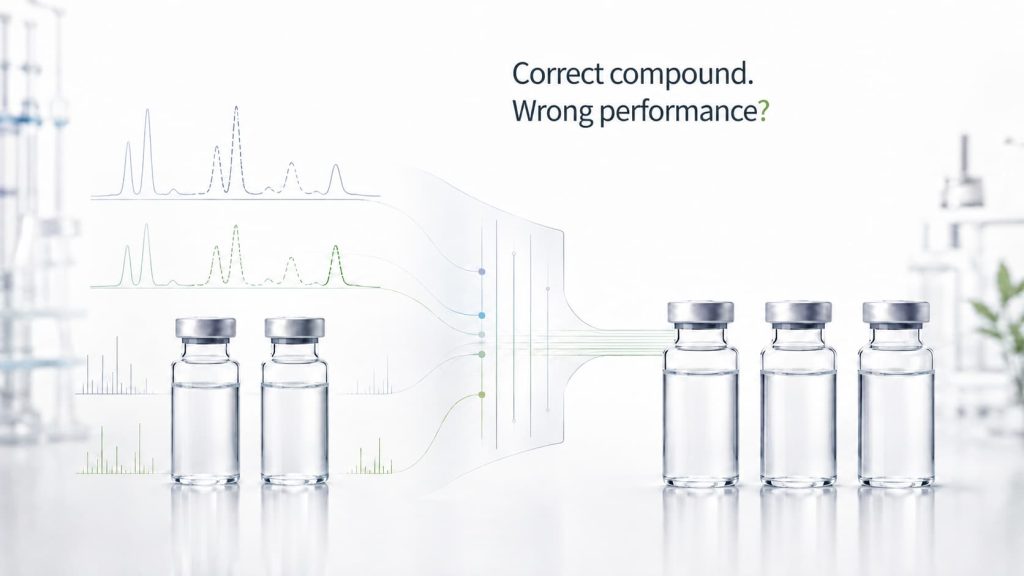
Correct chemical identity alone does not guarantee application performance. Measurable quality attributes provide the basis for consistent repeat supply.
DIRECT ANSWER: If an established or commercially available compound has the correct identity but does not perform reliably in your application, higher nominal purity alone may not solve the problem. The relevant chemical and material attributes must first be identified and converted into measurable acceptance criteria. ChiroBlock can then assess and, where technically feasible, adapt the synthesis and purification process, manufacture a test batch against the agreed specification and establish reliable repeat supply.
The material is listed. The CAS number is correct. The certificate of analysis appears acceptable—yet the compound causes variable results, fails a sensitive process or is no longer available in the required quality. This is a specification and supply problem, not simply a sourcing problem.
What can you do when a catalog chemical does not work in your application?
Start by comparing material that works with material that does not. Analytical results, retained samples, application observations and supplier documentation can reveal which attributes correlate with performance. These findings can be translated into a testable target specification and used to guide synthesis, work-up, purification and release testing.
In practical terms: the task is to move from “this material does not work” to “these measurable attributes distinguish acceptable from unacceptable material.”
Why can compounds with the same CAS number perform differently?
A CAS number identifies a chemical substance, but it does not fully describe every property of a supplied material. Two batches can have the same stated identity and a similar assay while differing in attributes that matter to the intended use.
Possible causes include:
- individual impurities or by-products;
- residual solvents, metals or catalyst residues;
- water content;
- chiral purity or another isomer ratio;
- salt, solvate, polymorphic or other solid-state form;
- color, particle size or thermal behavior;
- degradation products and storage stability; and
- batch-to-batch variation that is not visible in a single headline purity value.
A statement such as “99% pure” is therefore not, by itself, evidence that a compound is suitable for a sensitive bioprocess, diagnostic method, functional material or industrial production step. The decisive question is whether the material meets the attributes and limits required by the application.
What does fit-for-purpose compound quality mean?
Fit-for-purpose compound quality means that the chemical and material properties relevant to the intended use have been defined, measured and controlled within agreed limits. It does not mean that chemical analytics alone can guarantee functional performance.
ChiroBlock tests the agreed chemical quality attributes. Functional application testing is normally performed by the customer or a designated laboratory unless a different scope is explicitly agreed. The test method, responsibility and acceptance criterion should be defined before functional qualification.
From an application problem to a testable chemical specification
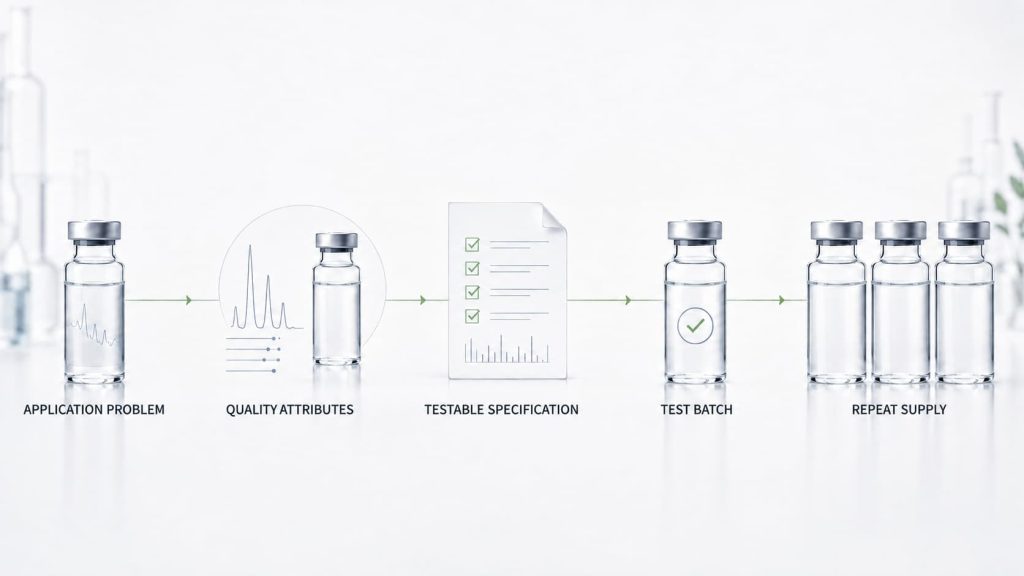
Application problem → quality attributes → testable specification → test batch → repeat supply.
- Describe the specification gap. Record what happens in the application and how acceptable and unacceptable material differ.
- Identify candidate quality attributes. Review analytical data, supplier certificates, retained samples, route knowledge and relevant material properties.
- Define measurable criteria. Convert the evidence into target values, limits, analytical methods and acceptance criteria.
- Adapt synthesis and purification. Investigate where critical components arise or remain and modify the route, work-up or purification where technically feasible.
- Manufacture and assess a test batch. ChiroBlock evaluates the agreed chemical criteria; the customer or designated laboratory evaluates application performance.
- Establish repeat supply. Once the target quality has been confirmed, define the manufacturing, release and change-control framework for future batches.
A detailed framework for identifying relevant quality attributes, selecting suitable test procedures and defining measurable acceptance criteria is provided under developing a chemical specification from application requirements.
Which application-specific quality attributes can be considered?
The appropriate specification depends on the compound, its intended use and the available analytical evidence. Relevant requirements may include:
- identity and assay;
- a defined impurity or by-product profile;
- tighter limits for residual solvents, metals or catalyst residues;
- specified water content;
- salt, solvate or solid-state form;
- chiral purity or another isomer ratio;
- color, particle-size range, thermal behavior or stability; and
- other measurable attributes shown to be relevant to the application.
Not every parameter is technically meaningful or controllable for every compound. The useful specification is therefore developed from evidence rather than assembled as an arbitrary list of narrow limits.
How can synthesis and purification be adapted to the required specification?
The impurity profile and material properties of a compound are influenced by the selected starting materials, reaction pathway, reagents, catalysts, process conditions, work-up, purification and isolation. A specification gap may therefore require more than additional final-stage purification.
If the established synthesis route must be fundamentally changed to control impurities, improve reproducibility or enable scale-up, ChiroBlock can optimize the synthesis route and develop it for scalable manufacture. Feasibility depends on the molecular structure, available route information, target limits and required quantity.
If the required target molecule itself is new or not commercially available, the appropriate starting point is the custom synthesis of new and non-commercially available molecules.
How is consistent repeat supply established?
A successful test batch is only the first step when the material will be needed again. Repeat supply requires a defined process and a release concept that preserve the agreed quality attributes across subsequent batches.
Depending on the project, this may include:
- defined starting materials and qualified sources;
- documented manufacturing and work-up procedures;
- agreed in-process controls and release analytics;
- batch documentation and traceability;
- retained reference information or samples where agreed; and
- controlled assessment of relevant changes.
For the transition from a qualified batch to ongoing manufacture, ChiroBlock provides quality-managed repeat synthesis from gram to kilogram scale. Quantity, frequency, documentation and testing scope are agreed for the individual project.
When is a custom second source useful?
An independent source may be relevant when a catalog product has been discontinued, supplier quality varies, lead times are unreliable or a critical material currently depends on a single manufacturer. A second-source project does not merely reproduce a product name: it defines the required material, establishes a technically suitable route and agrees how equivalence or suitability will be assessed.
ChiroBlock can assess whether an established compound can be manufactured as an independent source. The customer remains responsible for application-specific approval unless another testing scope has been agreed.
For a detailed explanation of source qualification, batch consistency, traceability and project-specific change management, see Recurring Supply to a Custom Specification and Qualified Second Source.
Which information helps ChiroBlock assess the project?
A complete specification is helpful but not always required at the beginning. Please provide as much of the following information as is available:
- compound name, structure, CAS number and required form;
- current specification and certificates of analysis;
- analytical data from acceptable and unacceptable batches;
- samples of existing material, where available and legally transferable;
- a factual description of the observed application problem;
- known critical impurities or target limits;
- required batch size, annual demand and delivery frequency;
- documentation, packaging and storage requirements; and
- the planned customer-side application test and acceptance criterion.
This information allows the project to be divided into sensible stages: analytical comparison, specification development, route or purification work, test-batch manufacture, application evaluation and repeat supply.
How are scope, cost and commercial risk defined?
Cost depends on the compound, route maturity, analytical effort, target limits, purification complexity, scale, documentation and supply frequency. A narrow limit can be disproportionately demanding if the relevant impurity is difficult to remove or the analytical method must first be developed.
Exploratory work and clearly defined delivery projects require different commercial structures. ChiroBlock therefore agrees the technical stages, responsibilities, acceptance criteria and contractual model before work begins. See costs and contract models for custom synthesis for the available approaches.
Why ChiroBlock for synthesis to specification and repeat supply?
ChiroBlock combines custom synthesis, route and purification development, chemical analytics and recurring manufacture within one project pathway. Since 1999, the company has worked on customer-specific compounds from milligram to kilogram quantities and does not operate a catalog business.
Its ISO 9001-certified quality management system provides the organizational framework for documented responsibilities and controlled processes. The exact analytical, documentation and regulatory scope remains project-specific. ISO 9001 certification is not the same as cGMP manufacture, and no such equivalence is implied.
NEXT STEP: Send us the available specification, analytical data, a sample or comparison data if available, the observed application gap and your expected demand. ChiroBlock will assess the technically appropriate route from specification development to repeat supply.
Further Reading
The following articles explore two central questions: When is a chemical compound genuinely available, and why is nominal purity alone insufficient to determine whether a material is suitable for a specific application?
- Is a chemical compound commercially available or not?
This article explains why a CAS number or catalog listing does not establish actual availability or application suitability. Chemical form, quantity, lead time, specification and reproducible quality must also be considered. - Compound purity and pricing – some facts beyond the gut feeling
This article explains why the identity of individual impurities may be more important than total nominal purity and why tighter specifications can increase synthesis and purification effort disproportionately. - API supply-chain case study: when 99% purity was not enough — A pharmaceutical project showing how ChiroBlock identified a hidden quality gap, developed a robust process and established reliable supply from two independent sources.
Frequently asked questions
Why can a compound with 99% purity still be unsuitable?
The remaining 1% may contain a critical impurity, but total assay is not the only possible cause. Residual metals, solvents, water, isomer ratios, solid-state properties, particle size or degradation can also influence the application.
Can ChiroBlock manufacture an established compound to tighter limits?
ChiroBlock can assess whether the synthesis, work-up or purification can be adapted to meet tighter limits. Feasibility, analytical effort and cost depend on the compound and the target specification.
Must the final specification already be available?
No. Existing data, supplier documentation, samples of acceptable and unacceptable material and application observations can support the definition of suitable chemical acceptance criteria.
Who performs the functional application test?
Normally the customer or a designated laboratory. ChiroBlock evaluates the agreed chemical quality attributes unless a different testing scope is explicitly included in the project.
Can ChiroBlock replace a discontinued catalog product?
Potentially. ChiroBlock can assess reproduction or development of a suitable alternative when the structure, required form, target quality and evaluation criteria are sufficiently defined.
Can ChiroBlock provide recurring small quantities?
Yes. Recurring supply of customer-specific fine and specialty chemicals in small and medium quantities is part of ChiroBlock's service. The technically suitable scale and frequency are agreed for each project.
Can ChiroBlock serve as a second source?
Yes, provided that a suitable independent manufacturing route and qualification plan can be developed for the required compound.
How is batch-to-batch consistency supported?
Through agreed raw-material requirements, documented procedures, suitable in-process and release testing, traceability and controlled assessment of relevant changes. The exact control strategy is project-specific.
Is fit-for-purpose quality the same as the highest possible purity?
No. Fit-for-purpose quality means controlling the attributes that are relevant to the intended use. The highest technically achievable assay is not automatically the most meaningful or economical specification.
Does ISO 9001 mean that the compound is manufactured under cGMP?
No. ISO 9001 certifies ChiroBlock's quality management system. It does not by itself make a project or product cGMP-compliant. Any additional quality or regulatory requirements must be evaluated and agreed separately.
Discuss Your Specification Gap