
From Application Requirement to Chemical Specification
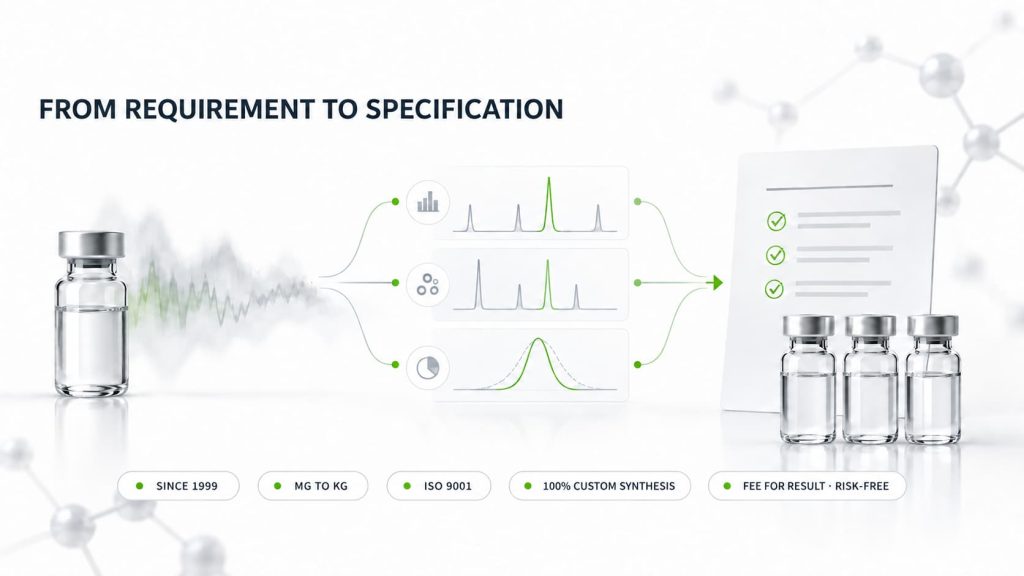
Application requirements are translated into measurable quality attributes, test procedures and acceptance criteria for reproducible chemical supply.
Direct answer: Chemical specification development translates an application requirement into measurable quality attributes, suitable test procedures and defined acceptance criteria. The objective is not to request the highest possible purity, but to describe the chemical and material properties that distinguish acceptable from unacceptable material for the intended use.
A compound may have the correct identity and still cause variable or unsuitable results. The underlying difference may relate to an individual impurity, residual solvent, metal content, water, isomer ratio, salt or solid-state form, particle characteristics, stability or another application-relevant attribute.
The purpose of a project-specific chemical specification is to make these requirements testable. It creates a shared basis for synthesis, purification, analytical assessment, qualification and, where required, recurring manufacture.
This page focuses specifically on the development of measurable chemical criteria. The complete service pathway—from an established compound with an unresolved quality problem to qualified repeat supply—is described under custom synthesis of established compounds to specification and reliable supply.
What Is a Chemical Specification?
A chemical specification is a documented set of quality attributes, test procedures and acceptance criteria used to determine whether a material meets agreed requirements.
A useful chemical specification states what must be controlled, how it will be measured and which result will be considered acceptable.
For a customer-specific compound, a specification may include chemical identity, assay, impurity limits, residual solvents, metals, water content, isomer ratio, salt or solid-state form, appearance, particle-related properties, stability or other measurable characteristics relevant to the application.
A specification is more than a list of desired values. A result such as “purity ≥ 99%” is incomplete if the analytical procedure, calculation basis, relevant individual impurities and decision rule are not defined. Different analytical procedures may produce results that cannot be directly compared.
The term “specification” is used here in a broad project-specific sense. Pharmaceutical projects may be subject to additional regulatory requirements. The official ICH Quality Guidelines provide an overview of internationally relevant pharmaceutical quality guidance.
When Is Chemical Specification Development Necessary?
Specification development becomes relevant when the required material quality cannot be described adequately by chemical identity, CAS number or a general supplier certificate.
Typical starting situations include:
- a material works in one batch but not in another;
- commercial material meets its catalog specification but fails the intended application;
- an individual impurity or residue is suspected to affect performance;
- the required salt, solvate, isomer or solid-state form is not adequately defined;
- a discontinued product must be replaced with a customer-specific alternative;
- a new supplier or independent second source must be qualified;
- a development batch must be converted into a reproducible supply specification; or
- the customer knows the functional requirement but cannot yet express it as measurable chemical criteria.
If the central question is whether a listed substance is genuinely obtainable in the required form, quantity and quality, see Is a chemical compound commercially available or not?
If the main question concerns the relationship between purity, specification and purification cost, see Compound purity and pricing—some facts beyond the gut feeling.
What Information Is Needed at the Beginning?
A complete final specification is not required before the project starts. Specification development can begin with the available evidence.
Useful starting information includes:
- compound name, structure, CAS number and required chemical form;
- description of the intended application and process conditions;
- the observed functional or quality-related problem;
- existing specifications and certificates of analysis;
- analytical data from acceptable and unacceptable batches;
- retained samples or reference material, where available and transferable;
- known impurities, degradation products or sensitive process parameters;
- current analytical procedures and reporting limits;
- the available functional application test;
- required quantity, expected annual demand and ordering frequency; and
- documentation, packaging, storage and regulatory requirements.
The most useful evidence is often a direct comparison between material that performs acceptably and material that does not. Such a comparison can help identify candidate attributes that would remain invisible in a routine certificate of analysis.
How Is an Application Requirement Converted into a Chemical Specification?
The process begins with the observed application gap and proceeds toward increasingly precise and testable criteria.
| Stage | Central question | Typical outcome |
|---|---|---|
| 1. Define the application gap | What happens when the material is used, and how does acceptable material differ from unacceptable material? | Factual problem statement, comparison basis and initial hypotheses. |
| 2. Identify candidate quality attributes | Which chemical or material properties could explain the observed difference? | Prioritized list of potentially relevant attributes. |
| 3. Define the testing approach | Which available procedures can measure the relevant attributes with sufficient selectivity and sensitivity? | Analytical plan, responsibilities and identified method gaps. |
| 4. Evaluate comparison or development batches | Do the selected attributes correlate with chemical quality and customer-side application results? | Evidence supporting, rejecting or refining the proposed criteria. |
| 5. Establish acceptance and supply criteria | Which limits, procedures and responsibilities should govern qualification and future batches? | Agreed target specification, acceptance logic and basis for repeat supply. |
The process is iterative. An initial hypothesis may be disproved, a previously overlooked attribute may become relevant, or the available analytical procedure may not distinguish acceptable and unacceptable material adequately. The specification should therefore be refined from evidence rather than created as an arbitrary list of narrow limits.
Which Quality Attributes May Be Relevant?
The appropriate attributes depend on the compound, synthesis route, intended use and available evidence. Not every possible parameter is relevant or technically controllable in every project.
| Attribute group | Possible examples | Typical project question |
|---|---|---|
| Identity and composition | Identity, assay, salt form, solvate or hydrate form | Is the supplied material the required chemical form and composition? |
| Isomeric composition | Chiral purity, enantiomeric ratio, geometric or positional isomers | Could a specific isomer influence function, safety or downstream processing? |
| Organic impurities | Starting materials, intermediates, by-products and degradation products | Which individual components require identification or a defined limit? |
| Process residues | Residual solvents, catalysts, metals, reagents or processing aids | Which route-related residues may affect the application? |
| Material properties | Water content, color, particle characteristics, solid-state form or thermal behavior | Which properties influence handling, processing, stability or performance? |
| Stability-related attributes | Degradation profile, storage sensitivity or change during transport | Which changes must be controlled over the agreed storage and supply period? |
In pharmaceutical development, some of these terms have defined regulatory meanings. In other industries, the same scientific principle may be useful without creating a pharmaceutical or cGMP claim. The applicable quality and regulatory framework must be agreed for the individual project.
What Must a Testable Acceptance Criterion Contain?
A measurable acceptance criterion should define more than a target number. Depending on the project, it may need to specify:
- the attribute being tested;
- the referenced analytical procedure;
- the unit and calculation basis;
- the target value, range or upper or lower limit;
- the treatment of individual and total impurities;
- the reporting, quantification or detection limit where relevant;
- the sample, sampling point or batch stage;
- the laboratory responsible for testing;
- the decision rule for acceptance, investigation or rejection; and
- the applicable version of the method and specification.
For example, “purity ≥ 99%” may be insufficient if it is unclear whether the result refers to HPLC area percentage, quantitative assay, corrected mass fraction or another basis. A specification must allow the parties to interpret the result consistently.
Are Analytical Procedure Development and Validation the Same?
No. Selecting or developing an analytical procedure and formally validating that procedure are separate activities.
During an exploratory project, the immediate need may be to compare batches, identify relevant differences or determine whether a candidate attribute can be measured meaningfully. Formal validation may only become appropriate after the analytical purpose, attribute, range and acceptance decision are sufficiently defined.
For relevant pharmaceutical projects, ICH Q14 describes scientific principles for analytical procedure development, while ICH Q2(R2) addresses validation of analytical procedures.
Characterization, analytical procedure development, method transfer and formal validation are not automatically the same project scope. Any required work, responsibility and documentation level must be expressly agreed before the project begins.
How Are Chemical Testing and Functional Application Testing Separated?
Chemical analysis can demonstrate whether agreed chemical and material attributes meet their defined criteria. It does not automatically prove that a compound will perform successfully in a biological, diagnostic, technical or material-science application.
| Responsibility | Typical scope |
|---|---|
| ChiroBlock | Synthesis, purification, agreed chemical characterization, documentation and assessment against the agreed chemical criteria. |
| Customer or designated laboratory | Functional, biological, process-specific, diagnostic or material-performance testing. |
| Jointly agreed | Test sequence, responsibilities, reference material, acceptance decision, feedback pathway and treatment of deviations. |
Unless a different scope is expressly agreed, the customer or a designated testing laboratory performs the functional application test. Its procedure, responsibility, acceptance limit and required reproducibility should be defined before a test batch is evaluated.
How Can Comparison Batches Support Specification Development?
Samples from acceptable and unacceptable batches can provide a practical starting point when the relevant quality attribute is not yet known.
A structured comparison may consider:
- supplier certificates and raw analytical data;
- differences in starting materials or manufacturing routes;
- individual impurity patterns rather than only total purity;
- residual solvents, metals, water or process residues;
- isomeric composition and chemical form;
- appearance, solid-state or particle-related differences;
- storage history and possible degradation; and
- the corresponding result from the customer’s application test.
A correlation does not automatically establish causation. Candidate attributes should be challenged with additional evidence or development batches where technically and commercially appropriate.
How Does the Specification Influence Synthesis and Purification?
The required impurity profile and material properties may depend on the complete manufacturing pathway. Starting-material quality, reaction sequence, reagents, catalysts, process conditions, work-up, purification, isolation and storage can all influence the final material.
If a critical attribute cannot be controlled by final-stage purification alone, the synthesis route or process may need to be adapted. ChiroBlock’s process development and synthesis route scouting addresses projects in which an established route must be redesigned or optimized.
The feasibility of a target specification depends on the molecular structure, route chemistry, available analytical procedures, target quantity and required limits. A narrower limit is not automatically achievable, scientifically meaningful or economically proportionate.
How Does a Development Specification Become a Repeat-Supply Specification?
A development or qualification batch is only the beginning when the compound will be required repeatedly. After the relevant attributes and acceptance criteria have been confirmed, the project can define how they will be controlled in future batches.
This may include:
- defined starting-material requirements and approved sources;
- documented synthesis, work-up, purification and isolation procedures;
- identified critical process and quality parameters;
- agreed in-process controls and release testing;
- batch documentation and traceability;
- retained information or reference samples where agreed;
- defined handling of deviations and atypical results; and
- controlled evaluation of relevant changes.
ChiroBlock’s SupplyChainFactory supports the transition from a qualified customer-specific compound to recurring, documented manufacture from gram to kilogram scale. Quantity, frequency, analytical scope and documentation requirements are agreed for each project.
The subsequent qualification and supply framework is explained under recurring supply to a custom specification and qualified second-source development.
What Can a Specification-Development Project Deliver?
Depending on the agreed scope and the available evidence, project outputs may include:
- a structured description of the application and specification gap;
- a comparison of available batches, samples or analytical data;
- a prioritized list of candidate quality attributes;
- an agreed analytical and functional testing plan;
- a provisional target specification for development work;
- analytically characterized development or test batches;
- documented customer feedback from application testing;
- refined chemical acceptance criteria;
- recommendations for synthesis or purification changes; and
- a basis for qualification and recurring supply.
The precise deliverables depend on the compound and project. No formal analytical validation, regulatory approval or guarantee of functional performance is implied unless the corresponding scope and responsibilities have been expressly agreed.
How Are Scope, Cost and Commercial Risk Defined?
Project cost depends on the quality and completeness of the available data, number of candidate attributes, analytical effort, availability of comparison samples, need for method work, synthesis or purification complexity, target quantity and required documentation.
An exploratory specification-gap investigation cannot always be priced or accepted in the same way as a delivery project with a complete specification. ChiroBlock therefore defines project stages, responsibilities, deliverables and acceptance criteria before work begins. Further information is available under costs and contract models for custom synthesis.
What Should You Send for an Initial Assessment?
Please provide as much of the following information as is available:
- compound identity, structure and required form;
- intended application;
- observed application or quality problem;
- current specification and certificates of analysis;
- analytical data or transferable samples from acceptable and unacceptable material;
- known or suspected critical attributes;
- available analytical and functional test procedures;
- required quantity and expected repeat demand; and
- quality, documentation and regulatory requirements.
You do not need to present a finished specification. Existing observations, comparison data and samples can form the basis of a confidential initial assessment.
Frequently Asked Questions About Chemical Specification Development
Must the final chemical specification already be available?
No. Specification development can begin with application observations, existing certificates, analytical data and samples from acceptable or unacceptable batches.
Is a certificate of analysis sufficient?
Not necessarily. A certificate only reports the attributes included in the supplier’s specification. It may not address the properties that determine suitability for your specific application.
Who identifies the relevant quality attributes?
Candidate attributes are developed from the available chemical, process and application evidence. ChiroBlock and the customer agree the chemical questions, responsibilities and evaluation plan within the project scope.
Are comparison samples required?
No, but samples or data from acceptable and unacceptable batches can substantially improve the assessment when the relevant quality difference is not yet known.
Does a specification always require 99% purity?
No. The appropriate specification controls the attributes relevant to the intended use. A lower overall assay with controlled non-critical components may be more suitable than a higher assay containing a critical impurity.
Does ChiroBlock perform the functional application test?
Normally the customer or a designated laboratory performs the functional test. A different responsibility must be expressly agreed before the project begins.
Is analytical procedure validation automatically included?
No. Characterization, analytical procedure development, transfer and formal validation are separate activities. Any required scope and documentation level must be agreed explicitly.
Can acceptance limits change during development?
Yes. Provisional limits may be refined when new analytical, synthesis or application evidence becomes available. Changes should be documented and agreed before they are used for qualification or release decisions.
Does an ISO 9001-certified quality management system mean cGMP manufacture?
No. ISO 9001 certification describes ChiroBlock’s quality management system. It does not automatically make a project or material cGMP-compliant. Additional regulatory requirements must be evaluated and agreed separately.
What happens after the specification is confirmed?
The agreed attributes, procedures and acceptance criteria can provide the basis for a qualified test batch and, where required, documented repeat supply under a project-specific control framework.
What is the first step?
Send the compound identity, intended application, available specification and analytical data, observed quality gap, required quantity and information about the functional test. ChiroBlock will review the available information confidentially and propose an appropriate project structure.
Contact ChiroBlock to discuss your specification-development project