
New World Screwworm in the United States: How Chemistry Supports Parasite Research
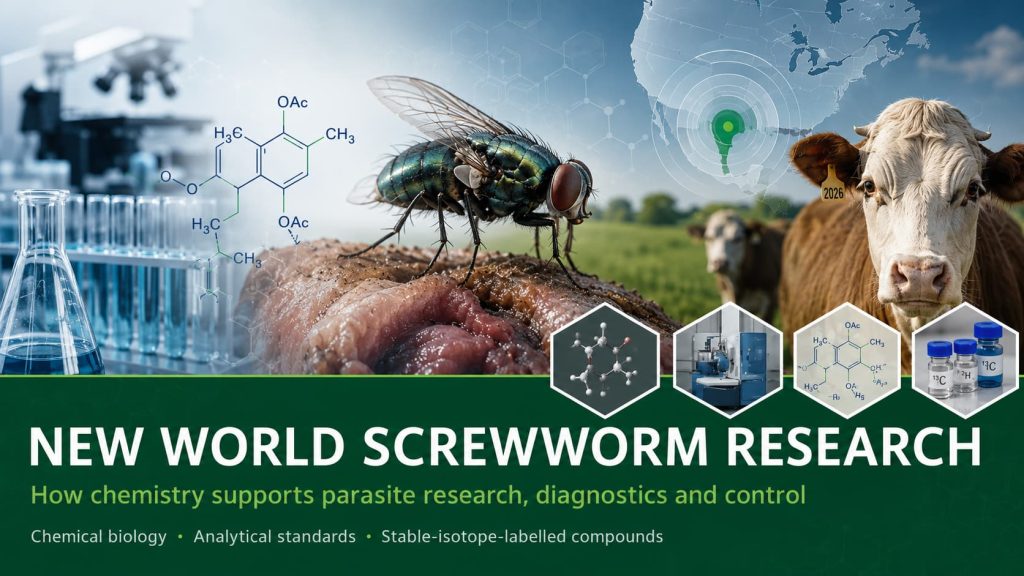
Last reviewed: July 29, 2026
Current-status notice: New World screwworm detections, response zones, animal-movement requirements and sterile-fly release areas may change rapidly. Operational decisions should always be based on the current USDA APHIS dashboard and the responsible state animal-health authorities.
The return of New World screwworm detections to the United States demonstrates how quickly an animal-health problem can connect livestock management, wildlife surveillance, international trade and scientific research.
The New World screwworm, Cochliomyia hominivorax, is a parasitic blowfly whose larvae feed on the living tissue of warm-blooded animals. Even a relatively small wound can provide a site for egg deposition. Without early diagnosis and treatment, the resulting wound myiasis may progress rapidly and cause extensive tissue damage, secondary infection, severe animal suffering and death.
The United States previously eliminated established New World screwworm populations through the Sterile Insect Technique. Confirmed detections during 2026 have renewed attention to surveillance, livestock biosecurity, sterile-fly production and the scientific tools required to understand and control parasites.
This article examines where chemistry fits into that response. It also explains ChiroBlock’s documented contribution to a peer-reviewed parasite study involving specialised and isotope-labelled research compounds.
Executive Summary
New World screwworm control depends on the combination of early detection, veterinary treatment, animal-movement safeguards, fly surveillance and large-scale releases of sterile flies.
Modern research strengthens these measures through genomics, molecular diagnostics, population tracing, chemical ecology, veterinary pharmacology and ecological modelling.
Synthetic chemistry contributes by providing defined molecules that may not be commercially available. These can include:
- analytical reference compounds,
- stable-isotope-labelled molecules,
- natural products and structural analogues,
- enzyme inhibitors,
- metabolites and degradation products,
- volatile attractant candidates and
- compounds for structure–activity relationship studies.
A relevant peer-reviewed example is the Nature Communications publication “A new class of natural anthelmintics targeting lipid metabolism.” The paper documents that ChiroBlock synthesised avocadane acetate and carbon-13-labelled avocadene acetate for the research.
Scientific clarification: This publication investigated free-living and parasitic nematodes. It was not a study of New World screwworm, wound myiasis or a screwworm treatment. Its relevance lies in demonstrating how custom-synthesised compounds support experimental parasitology and chemical biology.
New World Screwworm at a Glance
| Characteristic | Scientific information |
|---|---|
| Scientific name | Cochliomyia hominivorax |
| Organism | Parasitic blowfly |
| Destructive stage | Larval stage |
| Food source | Living tissue of warm-blooded hosts |
| Condition caused | Traumatic or wound myiasis |
| Potential hosts | Livestock, wildlife, companion animals and occasionally people |
| Principal population-control method | Sterile Insect Technique |
| Research disciplines | Veterinary medicine, entomology, genomics, chemical biology, analytical chemistry and synthetic chemistry |
What Is the New World Screwworm?
The New World screwworm is different from many other blowflies because its larvae require living host tissue for development. Other fly larvae may primarily consume dead or decomposing material. New World screwworm larvae actively invade viable tissue.
A female fly is attracted to wounds and certain natural body openings. Eggs may be deposited at the edge of an injury, surgical site or damaged area of skin. After hatching, the larvae enter the wound and feed collectively.
This feeding behaviour can enlarge and deepen the original lesion. The wound may become painful, inflamed, bleeding or foul-smelling. Secondary bacterial infections may further complicate the condition.
Animals that initially show only a minor wound can therefore deteriorate significantly when an infestation is not recognised and treated promptly.
Why the 2026 U.S. Detections Matter
The United States eradicated established New World screwworm populations in 1966. The success of this programme was one of the major achievements of area-wide insect control.
However, the parasite remained present in other parts of the Americas. From 2023 onward, increasing cases and northward spread through Central America and Mexico placed growing pressure on the established geographical control barrier.
On June 3, 2026, USDA confirmed New World screwworm larvae in a three-week-old calf in Zavala County, Texas. Additional detections subsequently led to expanded surveillance, response zones, animal-movement safeguards and sterile-fly dispersal.
A confirmed animal infestation does not automatically prove that a permanent, self-sustaining fly population has become established throughout a county, state or wider region.
Authorities assess multiple types of evidence, including:
- the animal’s movement history,
- the developmental stage of collected larvae,
- additional cases in epidemiologically connected animals,
- fly-trap results,
- confirmed wild-fly detections,
- wildlife surveillance and
- evidence of continued local transmission.
Current case data should therefore be interpreted through the official live-status systems rather than through isolated numbers quoted in a static article.
View the current USDA APHIS New World screwworm status
Why Cattle Are Particularly Vulnerable
Cattle are important hosts because normal livestock production inevitably involves occasions when wounds can occur.
Potential entry sites include:
- healing umbilical wounds in newborn calves,
- calving-related injuries,
- castration or dehorning sites,
- branding and identification wounds,
- ear-tag injuries,
- tick bites and other parasite-related lesions,
- wire cuts and pasture injuries,
- hoof and leg wounds,
- surgical incisions and
- wounds around the eyes, ears, mouth or genital region.
The risk is especially relevant in extensive production systems. Animals grazing over large areas may not be examined closely every day, and a small wound can be difficult to recognise before larvae have begun feeding.
The impact extends beyond treatment of one animal. An outbreak can create additional labour, veterinary expenditure, production losses, delayed animal movements, certification requirements and wider disruption to livestock supply chains.
Early detection is therefore both an animal-welfare measure and an economic control measure.
How the Sterile Insect Technique Works
The Sterile Insect Technique, commonly abbreviated as SIT, is an area-wide population-control method based on mass rearing, sterilisation and release of the target insect.
- New World screwworm flies are raised in specialised production facilities.
- The insects are sterilised before release.
- Large numbers of sterile flies are dispersed over the target area.
- Sterile males compete with fertile wild males for mating opportunities.
- A female that mates with a sterile male produces no viable offspring.
- Repeated releases reduce reproduction within the wild population.
Because female New World screwworm flies normally mate only once, a sufficiently high ratio of sterile to fertile males can progressively suppress a wild population.
SIT contributed to the elimination of established New World screwworm populations from the United States in 1966 and to the eradication of a smaller Florida Keys outbreak in 2017.
Sterile flies cannot produce viable larvae. Their release does not cause new screwworm infestations. However, SIT does not replace individual-animal examination, wound treatment, laboratory identification or movement controls.
Learn how USDA uses the Sterile Insect Technique
Why Scientific Innovation Is Still Needed
The Sterile Insect Technique is proven, but its implementation requires a large and continuously operating infrastructure.
Effective eradication depends on:
- production of sufficient numbers of competitive sterile males,
- reliable insect-rearing systems,
- quality control of released flies,
- aircraft and ground-release infrastructure,
- accurate distribution planning,
- rapid detection of new infestations and
- continuous evaluation of field data.
Modern research can improve the complete response system rather than replacing it with a single new technology.
Priority Research Areas
Important areas include:
- Genomics: improved understanding of sex determination, population structure and genetic variation.
- Molecular diagnostics: faster identification of larvae and differentiation from other fly species.
- Population tracing: determining the likely geographical origin of detected insects.
- Chemical ecology: identifying host odours and volatile compounds involved in attraction and egg-laying behaviour.
- Trap development: increasing sensitivity and selectivity while reducing operational complexity.
- Veterinary research: evaluating safe preventive and therapeutic options for affected animal species.
- Wildlife surveillance: detecting infestations outside conventional livestock systems.
- Ecological modelling: combining environmental, animal-movement and surveillance data to guide response activities.
Where Chemistry Contributes to Parasite Research
Biological research frequently begins with an observation: a natural extract changes parasite behaviour, a volatile substance attracts an insect, or a chemical treatment alters development or metabolism.
Understanding that observation requires defined chemical materials.
Researchers may need to determine:
- which molecule caused the effect,
- whether the effect can be reproduced with pure material,
- which structural features are essential,
- how the molecule is metabolised,
- whether related compounds behave differently and
- which biological target or pathway may be involved.
These questions may be impossible to answer with an undefined extract, variable biological sample or incompletely characterised commercial material.
Defined Research Compounds
Custom synthesis allows a proposed molecular structure to be converted into a chemically characterised research tool.
Relevant compound classes can include:
- natural products,
- natural-product analogues,
- enzyme inhibitors,
- metabolites,
- degradation products,
- analytical reference substances,
- impurity standards,
- fluorescent or affinity probes,
- volatile compounds and
- structure–activity relationship series.
The required compound may be entirely new, unavailable in the necessary stereochemical form, required at an unusual purity or needed in a quantity that cannot be obtained from a catalogue supplier.
Stable-Isotope-Labelled Compounds
A stable-isotope-labelled compound contains one or more atoms replaced with a non-radioactive isotope, such as carbon-13, nitrogen-15 or deuterium.
The labelled molecule has a distinguishable analytical signature and can support investigations of:
- metabolic stability,
- degradation pathways,
- compound uptake,
- distribution,
- metabolite formation,
- binding or incorporation and
- quantitative analytical methods.
Isotopic labelling does not automatically establish a biological mechanism. It provides an experimental tool with which researchers can follow a compound more precisely.
Defined Volatile Compounds
Chemical ecology investigates how organisms use chemical signals to interact with their environment.
Female New World screwworm flies are attracted to wounds and host-associated odours. These odour profiles may contain many compounds produced by the host, microorganisms, damaged tissue and metabolic processes.
Analytical chemistry can identify candidate volatile molecules. Custom synthesis can then provide those compounds individually or in controlled mixtures for behavioural experiments.
This approach can help determine which components genuinely influence attraction and which are only coincidentally present in a complex biological sample.
A Documented ChiroBlock Contribution to Parasite Research
A peer-reviewed study published in Nature Communications examined a group of avocado-derived fatty alcohols and acetates as potential anthelmintic compounds.
Publication: Fahs, H. Z., Refai, F. S., Gopinadhan, S. et al. “A new class of natural anthelmintics targeting lipid metabolism.” Nature Communications 16, 305 (2025).
DOI: 10.1038/s41467-024-54965-w
The study investigated free-living and parasitic nematodes. Reported experiments examined effects on development, motility, embryogenesis, mitochondrial respiration and lipid metabolism.
The chemical-sources section of the publication states that ChiroBlock GmbH synthesised:
- avocadane acetate and
- carbon-13-labelled avocadene acetate.
The compounds provided defined chemical material for biochemical and analytical research. The isotope-labelled compound offered an analytically distinguishable molecular tool.
Scientifically accurate description: ChiroBlock contributed specialised research compounds through custom chemical synthesis. The biological study design, nematode experiments, target investigation and scientific interpretation were carried out by the publication’s authors and participating research institutions.
What the Nature Communications Study Does Not Show
The Nature Communications paper did not investigate:
- Cochliomyia hominivorax,
- New World screwworm larvae,
- wound myiasis,
- sterile-fly releases,
- screwworm attractants or repellents or
- a veterinary treatment for New World screwworm.
Nematodes are roundworms. New World screwworm larvae are insects. These organisms differ substantially in their physiology, development, metabolism and molecular targets.
Activity in a nematode model therefore cannot be transferred directly to a parasitic fly. Related research can generate hypotheses, experimental methods and useful chemical tools, but biological conclusions require direct validation in the relevant organism.
Maintaining this distinction is essential for scientific credibility.
Why Custom Synthesis Matters in Interdisciplinary Research
A custom synthesis laboratory can make a significant contribution to a research programme without being responsible for the complete biological investigation.
A typical chemical-biology workflow may include:
- A biological screen identifies an active extract or molecule.
- Researchers propose which molecular structure may be responsible.
- The target compound is isolated, purchased or synthesised.
- Identity and purity are confirmed analytically.
- Structural analogues are prepared.
- Biological activity is compared across the compound series.
- Labelled compounds or probes are produced for mechanistic studies.
- Biochemical and genetic experiments investigate the proposed target.
- The results generate new hypotheses for further research.
Biology guides the next chemical question, and new compounds enable more precise biological experiments.
How ChiroBlock Supports Research Teams
ChiroBlock has specialised in chemical custom synthesis and contract research since 1999. Our work focuses on complex, novel and commercially unavailable molecules for pharmaceutical, biotech, diagnostic, academic and industrial research.
Relevant capabilities include:
- first-time synthesis of novel compounds,
- natural products and structural analogues,
- stable-isotope-labelled compounds,
- analytical and reference standards,
- metabolites and impurity standards,
- route scouting and synthesis development,
- process optimisation and scale-up,
- quantities from milligram to kilogram scale,
- analytical characterisation and documentation and
- confidential and IP-secure project handling.
Our task is to transform the requested molecular structure into a reproducible and characterised compound suitable for its intended research application.
Explore ChiroBlock’s chemical custom synthesis service
Learn about customised reference and analytical standards
What Information Is Needed for a Research Compound Request?
A clear project request allows the synthesis strategy, analytical scope and technical risks to be evaluated more accurately.
| Information | Why it matters |
|---|---|
| Target structure | Defines constitution, stereochemistry, salt form and any isotope-labelling position |
| Required quantity | Influences route design, purification and scale |
| Target purity | Must be aligned with the intended biological or analytical use |
| Intended application | Clarifies whether the compound is needed for screening, tracing, assay development or reference use |
| Analytical requirements | Defines the expected characterisation and documentation |
| Known literature | Existing routes and data can support feasibility assessment |
| Previous attempts | Failed or incomplete routes provide valuable technical information |
| Future demand | Allows repeat synthesis and potential scale-up to be considered from the beginning |
Frequently Asked Questions
What is the New World screwworm?
The New World screwworm, Cochliomyia hominivorax, is a parasitic blowfly whose larvae feed on the living tissue of warm-blooded animals. Infestation causes traumatic or wound myiasis.
Why is New World screwworm dangerous to cattle?
Female flies may deposit eggs around relatively small wounds. The larvae hatch and invade living tissue, causing progressive injury, pain, inflammation, secondary infection and potentially death when treatment is delayed.
Is New World screwworm established throughout the United States?
Confirmed animal or wild-fly detections do not by themselves demonstrate permanent establishment throughout a state or country. Authorities combine case investigations, fly trapping, surveillance and evidence of continued transmission when assessing establishment.
How does the Sterile Insect Technique control New World screwworm?
Mass-reared sterile males are released into affected areas. Females that mate with sterile males produce no viable offspring. Repeated releases can progressively suppress and eradicate a wild population.
Can released sterile flies cause screwworm infestations?
No. Sterile flies cannot produce viable larvae. They are released specifically to interrupt reproduction within the wild population.
How can chemistry support New World screwworm research?
Chemistry can provide defined host-odour compounds, analytical standards, isotope-labelled molecules, inhibitors, probes and structural analogues. These may support behavioural research, diagnostics, metabolic studies and development of traps or research assays.
Why are stable-isotope-labelled compounds useful?
Their distinguishable analytical signature can help researchers study compound uptake, metabolism, degradation, distribution and formation of metabolites.
Was the cited Nature Communications publication a New World screwworm study?
No. The study investigated free-living and parasitic nematodes. It did not investigate Cochliomyia hominivorax, wound myiasis or screwworm treatment.
What did ChiroBlock contribute to the Nature Communications study?
The publication states that ChiroBlock synthesised avocadane acetate and carbon-13-labelled avocadene acetate. ChiroBlock’s documented role was the custom synthesis of defined research compounds.
Does successful compound synthesis prove biological activity?
No. Synthesis confirms that a defined chemical material has been prepared and characterised. Biological activity, selectivity, safety and efficacy require separate experimental validation.
Summary
The New World screwworm, Cochliomyia hominivorax, is a parasitic blowfly whose larvae feed on living tissue and cause traumatic or wound myiasis.
The United States eradicated established New World screwworm populations in 1966 using the Sterile Insect Technique. Confirmed U.S. detections in 2026 renewed surveillance, animal-movement controls, veterinary preparedness and sterile-fly dispersal.
The Sterile Insect Technique works by releasing mass-reared sterile flies. Females that mate with sterile males produce no viable offspring, reducing reproduction in the wild population. Individual infested animals still require professional diagnosis, larval removal, wound care and appropriate veterinary treatment.
Modern New World screwworm research includes genomics, molecular diagnostics, population tracing, chemical ecology, veterinary pharmacology, trap development, wildlife surveillance and ecological modelling.
Custom chemical synthesis supports parasite research by providing non-commercial compounds, structural analogues, analytical standards, metabolites, volatile research compounds and stable-isotope-labelled molecules.
The Nature Communications publication “A new class of natural anthelmintics targeting lipid metabolism” investigated nematodes rather than New World screwworm. Its methods state that ChiroBlock synthesised avocadane acetate and carbon-13-labelled avocadene acetate.
ChiroBlock’s documented contribution was the custom synthesis of defined research compounds. It should not be described as direct New World screwworm research or as development of a screwworm treatment.
Conclusion
The New World screwworm demonstrates why effective parasite control requires both operational readiness and long-term scientific research.
Early recognition protects individual animals. Veterinary treatment limits tissue damage. Surveillance and movement controls reduce the risk of geographical spread. Sterile-fly releases suppress reproduction at population level.
Scientific research strengthens every stage of this response. Genomics helps characterise populations. Molecular diagnostics improve identification. Chemical ecology investigates host-finding behaviour. Analytical chemistry measures relevant compounds, while custom synthesis supplies defined molecular tools that cannot be obtained commercially.
ChiroBlock’s documented contribution to the Nature Communications nematode study illustrates this enabling role. The synthesis of avocadane acetate and carbon-13-labelled avocadene acetate provided specialised research materials for an interdisciplinary scientific project.
The role of a custom synthesis laboratory is not to replace biological research. It is to provide the defined, characterised molecules that make precise biological questions experimentally testable.
Discuss Your Research Compound
Do you require a novel molecule, stable-isotope-labelled compound, natural-product analogue, metabolite or analytical standard that is not commercially available?
Submit the target structure, requested quantity, purity and intended application for a confidential scientific feasibility assessment.
Discuss your custom synthesis project with ChiroBlock
Sources and Further Reading
- USDA APHIS: Current Status of New World Screwworm
- USDA APHIS: Using the Sterile Insect Technique to Fight Screwworm
- CDC: About New World Screwworm
- World Organisation for Animal Health: New World Screwworm
- Fahs et al.: A New Class of Natural Anthelmintics Targeting Lipid Metabolism
- ChiroBlock: Chemical Custom Synthesis Service
- ChiroBlock: Customised Reference and Analytical Standards
Medical and veterinary disclaimer: This article provides general scientific information. It does not replace veterinary diagnosis, medical advice, current product labelling or instructions issued by the responsible animal-health and public-health authorities.